Mapping the Invisible: Documenting the Internal Career Experience @ The Home Depot
Role: Lead UX Designer & Research Strategist
Company: The Home Depot
Team: 22 working committee members across Talent Acquisition; 6 senior TA leadership stakeholders
Deliverables: Process maps (field + non-field), research synthesis, illustrated storyboards
The Problem
The Home Depot has over 400,000 associates across stores, distribution centers, and corporate offices — and a lot of them want to grow their careers internally. The problem was the experience to do that had never really been designed. It was fragmented, inconsistently understood, and didn't come close to the kind of intuitive, consumer-like experience associates expected.
Leadership wanted to change that. But before anything could be improved, the process had to be documented — and nothing had been written down. Not for associates, not for hiring managers, and not for the Talent Acquisition team running the show.
My Role
I led the user strategy for the Internal Career Experience initiative. My job was to document and align the end-to-end internal hiring journey for two associate populations:
Field associates — hourly store and distribution center employees
Non-field associates — salaried corporate employees and call center hourly associates
More than anything, my role was about getting 22 working committee members and 6 senior TA leaders aligned on a process that had never been formally written down — and making sure the research that followed was grounded in what actually needed to be validated.
The Approach
Facilitated Alignment Workshops
After having a kickoff, twice a week, I ran working sessions with committee members from across the organization — HRLT sponsors, PM leads, TA coordinators, and Recruiters and TA for field and non-field leaders. Before each session I sent homework: each member documented the hiring steps as they understood them from their part of the business. Then we'd spend the session surfacing differences, resolving contradictions, and building toward a shared view of the process.
Weekly, I presented updates to the 6 senior TA leaders to keep leadership in the loop and give the team a clear escalation path for decisions.
This wasn't a quick sprint — it was a multi-month facilitation effort that required as much relationship-building as it did design thinking.
Committee members filled out what they believed the steps were for each stage of the hiring process.
Assumption & Question Generation
Before going into the field, I ran an assumption generation session with the committee. Everyone surfaced things they believed to be true about the associate experience that hadn't been validated yet — how associates found openings, how they felt about approaching their manager, what they knew about CareerDepot and Workday.
From there, I worked with the Committee Leads to turn those assumptions into a set of research questions. We ended up with two interview guides — one for field associates, one for hiring managers — each mapped to the journey stages we'd been aligning on. Every question had a reason to exist.
Research: Listening to Associates
To get a wide enough range of perspectives, I coordinated a nationwide research effort with 8 UX designers conducting in-person interviews across 7 metro areas: New York City, Atlanta, Chicago, Austin, Knoxville, Salt Lake City, and San Diego — covering both store and distribution center associates.
I built out the full research prep package to keep things consistent: research brief, interview script, facilitator guidance, outreach email templates, consent forms, and a shared tracker. Recordings and transcripts were uploaded to a central folder after each session.
In total, we conducted 42 interviews with field associates who had applied for or moved into a new role within the last 90 days — whether they got it or not.
Miro served as our central collaboration hub — keeping all 8 UX designers aligned and giving every facilitator a single place to work from.
In total, we conducted 42 interviews with field associates who had applied for or moved into a new role within the last 90 days — whether they got it or not.
Synth of all the research data.
What the Research Revealed
1. Opportunities were mostly invisible
Most associates didn't find open positions through CareerDepot. They heard about them through a manager, a coworker, or a flyer in the break room.
"Usually word of mouth before it actually gets posted — leaders have an idea of who they want to move into that role before it opens."
If you didn't have the right relationship with leadership, you likely didn't even know the opportunity existed.
2. Two career sites, zero clarity
The Home Depot has two career sites — careers.homedepot.com for external candidates and CareerDepot for internal ones. They look nearly identical. Multiple associates had unknowingly applied through the external site for an internal position and didn't realize it until it was too late.
"I think we have a career page for outsiders and then one for current employees. They look the exact same so it is really confusing."
3. Internal candidates were treated like outsiders
The application experience made no distinction between a 7-year associate and a brand new external applicant. Associates had to re-enter information the company already had, store numbers were hidden, and there was no way to search by location.
"The fact that an internal candidate has the same process as external is frustrating. An internal candidate should be able to search and see open positions by store." — Head Cashier, 10+ months at THD
4. Feedback was rare, generic, or nonexistent
The biggest pain point after interviews was simple: silence. Weeks would pass with no word. And when feedback did come, it didn't help associates understand what to improve.
"They tell you they will get back to you with feedback, but it would come weeks later or you don't hear anything at all."
5. Impromptu interviews were common — and unfair
Associates regularly described being pulled off the floor mid-shift with zero notice to interview on the spot. After a full day of physical work, that's not a fair setting to evaluate someone.
"Interviewing while working, changing clothes, not being mentally rested... the decision isn't based on experience, but politics."
6. The process wasn't always real
In a number of cases, managers already had someone in mind before a position was posted. Some associates were going through a process that had already been decided. Others with the right manager relationships skipped it entirely. Either way, trust was gone.
The Deliverables
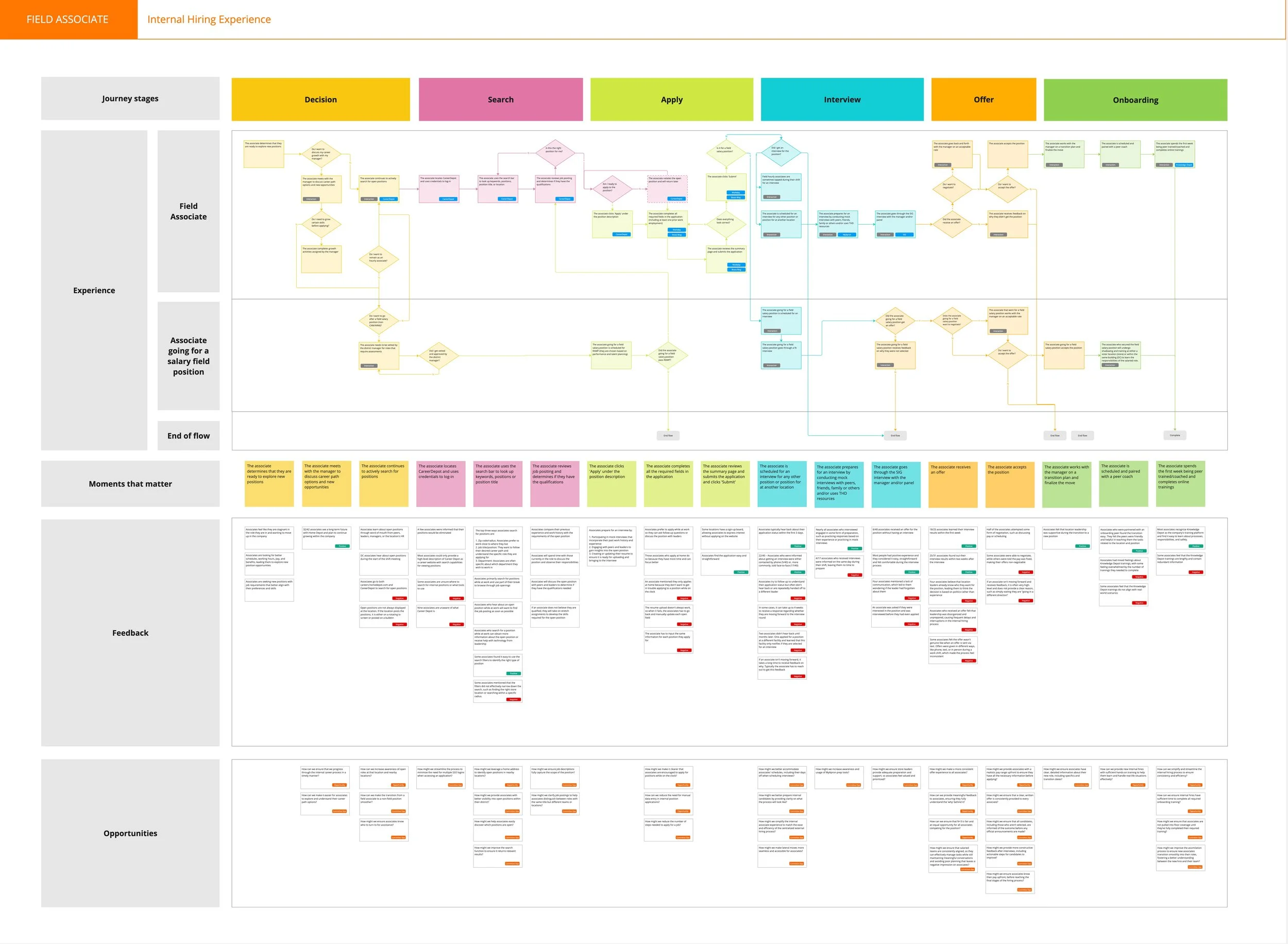
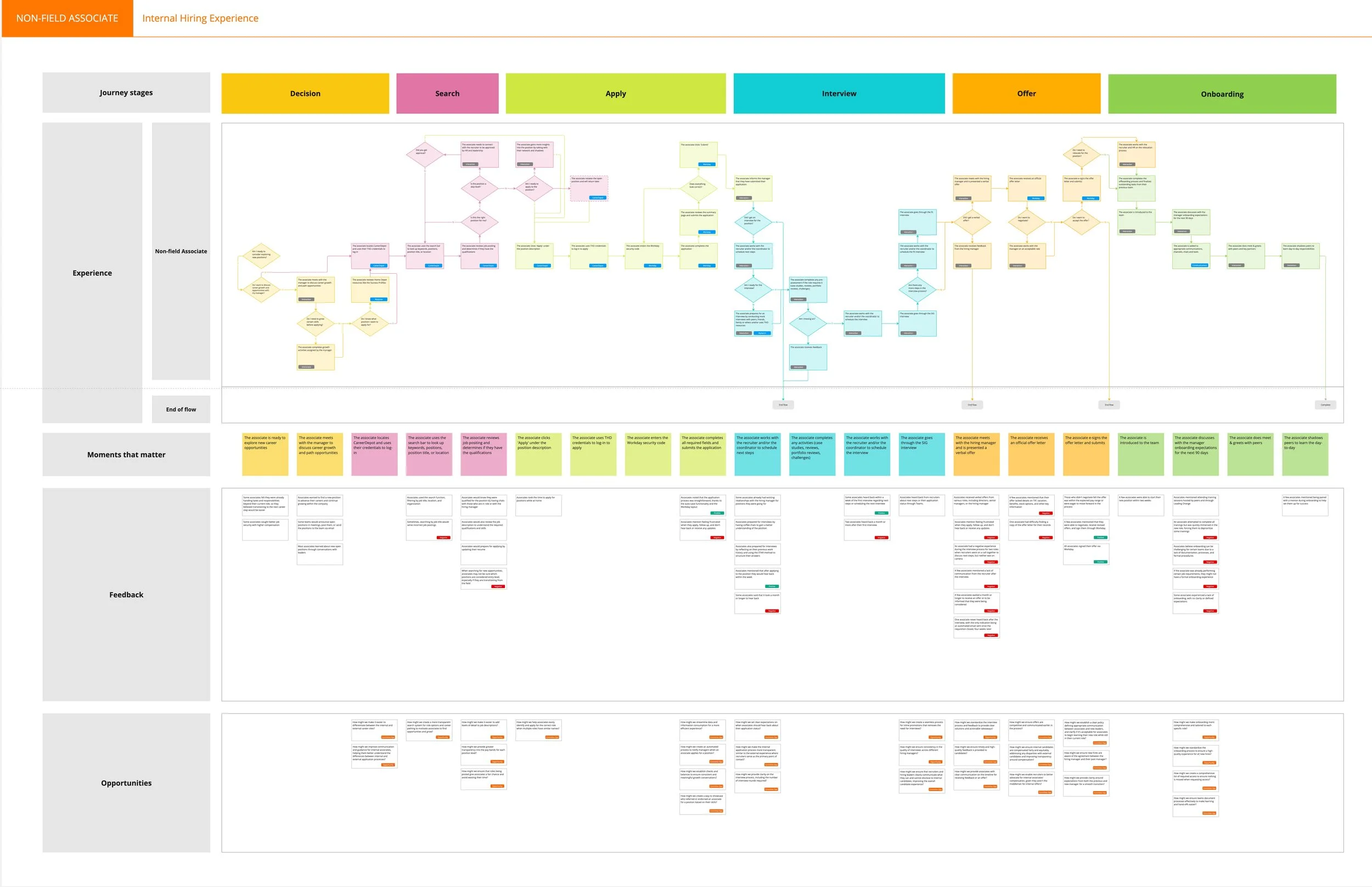
Process Maps: Field + Non-Field
The primary output of the alignment workshops was two comprehensive process maps — one for field associates and one for non-field associates — covering every stage of the internal hiring journey:
Decision → Search → Apply → Interview → Offer → Onboarding
Each map included:
Experience layer — the full process flow with decision trees, branching paths, and system touchpoints (CareerDepot, Workday, MyApron)
Moments that matter — the key steps where associate experience was most affected
Feedback layer — qualitative research findings layered directly onto each step, surfacing where friction was highest
Opportunity areas — design opportunities identified from the research, organized by stage
These maps were the first formal documentation of the internal hiring process in the company's history for this population. Before this project, no single source of truth existed.
Illustrated Storyboards
To bring the research to life for senior stakeholders, I developed illustrated storyboards for two personas — showing both a positive and negative version of the same journey.
Field Associate — An hourly store associate trying to move into a supervisor role. The negative experience hits every pain point: wrong career site, a surprise mid-shift interview, a week of silence, and a generic non-answer from her leader.
Salaried Leader (CXM → ASM) — A manager trying to move into an ASM role. The negative experience is a different kind of broken: a 6-month RAMP requirement, a position posted in another district that doesn't show up on CareerDepot, and a district HR manager who already knew the outcome before the interview happened.
The storyboards were designed to build empathy with leadership and serve as an alignment resource in future workshops.
Impact
Going into this project, there was no shared documentation of the internal hiring process, no common framework for identifying experience gaps, and stakeholders across HR, operations, and field leadership all had different — sometimes conflicting — understandings of how it worked.
By the end of Phase 1:
Two fully documented process maps were validated by 22 committee members and endorsed by 6 senior TA leaders
Research findings were synthesized and mapped directly to opportunity areas across both journeys
Committee leads had everything they needed to start identifying business process changes and drive improvements
Priority Shift
Due to a shift in HR priorities, I was moved to another project before Phase 2 began. The foundation was in place and ready to act on — the decision to pause was organizational, not a reflection of the work's readiness or direction.